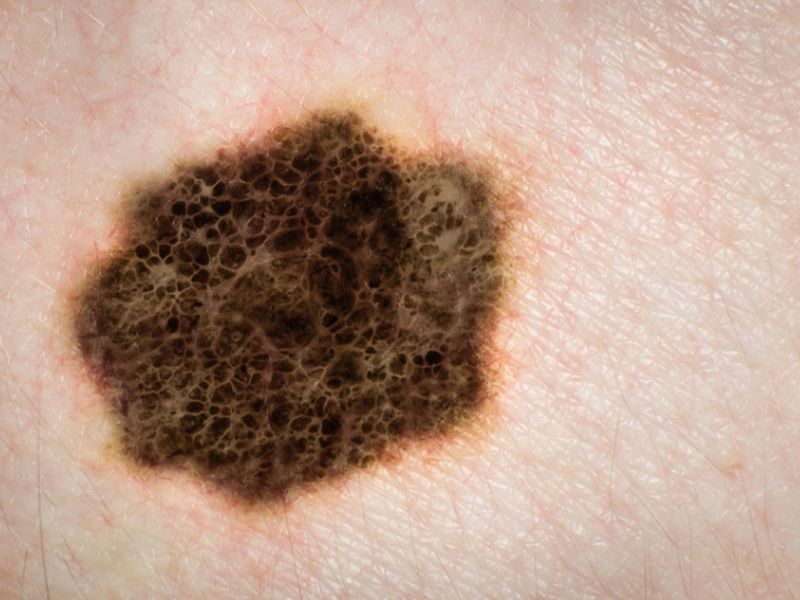
 MONDAY, April 11, 2016 (HealthDay News) -- Wider excision margins in thick cutaneous melanoma cases do not improve locoregional recurrence or melanoma-specific survival (MSS), according to research published online March 25 in Head & Neck. Olivia Ruskin, M.B.B.S., from the Peter MacCallum Cancer Centre in Melbourne, Australia, and colleagues reviewed the records of 108 patients (median age, 71.1 years) treated at a single site for head and neck melanoma between 2002 and 2012 (median follow-up, 40 months). The authors sought to assess the impact of excision margins and sentinel lymph node status on locoregional recurrence and MSS. The researchers found that the median Breslow thickness was 6.0 mm and locoregional recurrence happened in 27 percent of cases. There was no significant reduction in recurrence with margins ≥2 cm (P = 0.17), and there was no survival improvement with increasing margins (P = 0.58). Of the 59 patients (55 percent) who underwent sentinel node biopsy, 27 percent were positive. Patients who were sentinel lymph node-negative had a trend toward longer survival (P = 0.097). "Wider margins do not significantly improve locoregional recurrence or MSS," the authors write. "Sentinel lymph node involvement reflects a poor prognosis." |
Monday, April 18, 2016
SURGICAL MARGINS GREATER THAN 2 CM. DO NOT IMPROVE SURVIVAL IN MELANOMA
Excision Margins Don't Impact Melanoma Recurrence, SurvivalAlthough, sentinel lymph node involvement is tied to poor prognosis


IMPROVED SURVIVAL IN ADVANCED MELANOMA
More than one-third of advanced-melanoma patients given nivolumab in study are alive five years after starting treatment, researchers say
The Washington Post (4/17, Mcginley) reports in “To Your Health” that research indicated “more than a third of advanced-melanoma patients who received one of the new immunotherapy drugs in an early trial are alive five years after starting treatment – double the survival rate typical of the disease.” Investigators found “that 34 percent of patients with metastatic melanoma who received...nivolumab have survived.” The Post points out that “the five-year survival rate for patients with advanced melanoma who got other treatments was 16.6 percent between 2005 and 2011, according to the National Cancer Institute.” The findings were presented at the American Association for Cancer Research annual meeting.
Thursday, January 28, 2016
HER2/neu POSTIVE BREAST CANCER - IMPROVED OVERALL SURVIVAL WITH PERTUZUMAB
| PERJETA® (pertuzumab) is a HER2/neu receptor antagonist indicated in combination with Herceptin® (trastuzumab) and docetaxel for the treatment of patients with HER2-positive metastatic breast cancer who have not received prior anti‑HER2 therapy or chemotherapy for metastatic disease |
STAY AWAY FROM THOSE TANNING BEDS!
Melanoma risk higher for women under 40 who started indoor tanning in their teens, study finds
CBS News (1/27, Marcus) reports on its website that research published in JAMA Dermatology indicated that “women under 40 who started indoor tanning at a younger age and tanned more often have a higher risk of being diagnosed with melanoma.”
HealthDay (1/27, Reinberg) reports that investigators looked at “data on nearly 700 men and women ages 25 to 49 who were diagnosed with” melanoma “between 2004 and 2007 and compared them with a similar number of ‘controls.’” The study indicated that “women younger than 40 with melanoma reported starting indoor tanning earlier than women 40 to 49 – at about age 16 versus 25.” Additionally, “younger women with melanoma...reported more tanning sessions than older women – an average of 100 tanning sessions compared with 40 sessions for women diagnosed at 40 to 49.”
Sunday, January 24, 2016
MELANOMA DURING PREGNANCY
Women diagnosed with melanoma while pregnant may be at greater risk of metastasis, study suggests
Reuters (1/21, Rapaport) reports that a new study suggests that women who are diagnosed with melanoma during pregnancy or within a year of giving birth may be significantly more likely to have metastasis to other organs and tissues. Researchers also found that these women were also more likely to have cancer recur after treatment. The findings were published online Jan. 20 in the Journal of the American Academy of Dermatology.
Wednesday, January 6, 2016
GENETICS MAY DETERMINE CANCER SUSPECTIBILITY IN MANY CASES
Nearly one-third of all cancer cases may be linked to inherited genes, research finds
On its website, NBC News (1/6, Fox) reports that research published in the Journal of the American Medical Association suggests that approximately one-third “of all cancer cases can be blamed on inherited genes.”
STAT (1/6, Swetlitz) reports that investigators looked at data on “identical and fraternal twins in Denmark, Finland, Norway, and Sweden, who were part of the Nordic Twin Study of Cancer.”
Newsweek (1/6, Firger) reports that the researchers found that “overall heritability for cancer was 33 percent among the entire study population, and notably higher for certain types of cancers.” Newsweek adds, “Significant heritability was found in 58 percent of diagnosed skin melanomas, 57 percent of prostate cancers, 43 percent of non-melanoma skin cancers, 39 percent of ovarian cancers, 38 percent of kidney cancers, 31 percent of breast cancers and 27 percent of uterine cancers.”
HealthDay (1/6, Thompson) reports that the researchers also “identified a set of cancers in which genetics play a very small role.” This group includes “lung cancer (18 percent), colon cancer (15 percent), rectal cancer (14 percent), and head and neck cancer (9 percent).”
Wednesday, December 23, 2015
ALCOHOL DEATHS HAVE REACHED A NEW HIGH
US alcohol deaths have reached a 35-year high, CDC finds
The Washington Post (12/23, Ingraham) “Wonkblog” reports that US alcohol deaths have reached a “35-year high.” In 2014, some “30,700 Americans died from alcohol-induced causes, including alcohol poisoning and cirrhosis.” Excluded from this figure are “deaths from drunk driving, other accidents, and homicides committed under the influence of alcohol.” Were those deaths to be “included, the annual toll of deaths directly or indirectly caused by alcohol would be closer to 90,000, according to” a CDC report published Dec. 18 in the Morbidity and Mortality Weekly Report.
TIME (12/23, Chan) points out, “Excessive alcohol use is a leading cause of preventable death, according to the” CDC, accounting “for about 88,000 deaths each” year “from 2006 to 2010, health officials said.”
Subscribe to:
Posts (Atom)